|

|
Last blast of the Katy RailroadBy: Terri Jo Ryan, Waco Tribune-Herald July 26, 2004 |
|
Forty years ago today, it was the end of the line for the "Katy Railroad," the Missouri-Kansas-Texas Railroad Company's last passenger train through Waco. The 99-year-old company that had brought Midwestern wheat south and sent "Texas Tea" (oil) north had fallen onto hard times and dropped the passenger trade to concentrate its resources on freight. But for that last historic jaunt of steel and steam, dozens of people crowded aboard, including a Waco Times-Herald reporter named Tommy West who recorded his impressions for the old evening newspaper's Monday edition. July 26, 1964 was a Sunday, and Chris Hansen, a 24-year-old reporter for the morning paper, the Waco Tribune, recalled that he took his then 3-year-old son, Jeff, to see the last train that day after church services. "I would take pictures of my kids with historical things, like front pages of 'Kennedy shot' or the moon landing," he said. Hansen, who worked for the Trib from 1956-69, rose to the rank of night city editor before he left the paper for the photography department of Baylor. After 35 years, he's still there in the basement of Pat Neff Hall, custodian of history rather than daily chronicler of it. "My dad worked for the Katy, too," Hansen said in a recent interview. "He was a 'carman,' who inspected the cars when they came through Bellmead." David Chiles of Houston, 55, was in Waco recently with his 90-year-old mother to visit some family gravesites. Coming into town, he said, reminded him of his late uncle Harold Bennett Norsworthy of Sanger Avenue, who used to take him to see the trains at the downtown depot. The old depot then was located where the Waco Transit and the Greyhound Bus Station are located now in downtown Waco, in the 300 block of S. 8th street. "I've been a train buff all my life, ever since I was 4 or 5 . . . so for 50 years! I'm not a nut or a moron, just a railroad buff," he recalled with child-like enthusiasm. "I was always fascinated by the railroad. No doubt about it. That red engine and the stainless steel cars with the red-glass windows; cars that had been painted from Pullman green to red. It was something else." Chiles, an amateur historian of the old railway, said the Katy was forced to quit passenger service when it lost a lucrative contract hauling U.S. Mail to aggressively low-bids from trucking companies. Within a year of the last ride through Waco, all M-K-T passenger service ended when the last of the Katy's famous trains ran from Dallas to Kansas City. Like all the other railroad companies, the Katy became exclusively freight haulers. And although an "anemic, asthmatic child" who didn't get to ride the last Texas Special out of Waco, Chiles said he recalls the lore surrounding it. For example, he said, the engineer was Pomp Perry, 71, a 52-year veteran of the Katy. When Perry brought it into the San Antonio, 10 minutes early, he stepped down from the train and retired on the spot. Other historical accounts mention that one of the last riders was L.L. Langowski, who had been aboard the first M-K-T train to arrive at the San Antonio depot on Sept. 1, 1917. He had retired from the Katy four years earlier after 40 years of service. A.C. Bedgood, a 33-year Katy veteran, had the sad task of closing the ticket office. All Chiles has to remind him now of the glory days of the old Katy railway are several photographs taken by his uncle, who died three years ago, and his model train cars, pain-stakingly decorated to resemble the real thing. "There is no amount of money that would make me part with them," he said. "It's nostalgia." Good Katy Links: The Katy Railroad and the Last Frontier
|
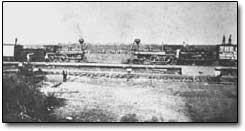
A brief history of the Katy and its most infamous episodeThe Missouri-Kansas-Texas Railroad Company (known as M-K-T or "Katy") began its corporate existence in the days following the Civil War and was intended to funnel business from Kansas City and points north and east to a new rail route being cut across Indian Territory and through Texas. The Katy, touted in advertisements as the "Gateway to Texas," breached the Lone Star State's frontier near the site of present-day Denison, where the first regular train arrived on Christmas Day, 1872. The Katy eventually expanded operations in Texas and reached Waco in the 1880s. One of the most infamous publicity stunts of all time, "The Crash at Crush," took place about 15 miles north of Waco, featuring two locomotives of the M-K-T intentionally set on a head-on collision course on Sept. 15, 1896. Advertised for months in advance, the event drew more than 40,000 spectators to a natural amphitheater three miles south of West formed in a shallow valley with hills rising on three sides. Katy Passenger Agent William George Crush, for whom the event's site was named, had proposed the spectacle as a way to sell $2 per round-trip ticket from anywhere in the state. A special four-mile track was laid for the collision run, and telegraph offices erected and water wells drilled. Workmen also constructed a grandstand for officials, speakers' stands, a platform for reporters and a bandstand. An eatery was set up in a tent borrowed from Ringling Brothers circus. A carnival midway sprang up, with medicine shows, game booths and cigar stands to entertain the spectators as they waited for the main event. Some 300 special policemen were brought in to keep order. Almost all train wreck fans were put on a hill at least 200 yards away for what the Dallas Morning News termed "a perfect view of the destruction." Only journalists were allowed to be within 100 yards of the track, for their own safety. The two engines, one green and one red and each pulling six cars covered with "gaudy advertising", slowly met at the point of collision to be photographed. Then the trains backed slowly up the low hills to their starting points. As they started their run, the two train crews abandoned their posts and jumped from the train. At impact, estimated to be at 50 miles per hour for each engine, the smashing of metal and splintering of timber filled the air. But just as the dust from the smoking heap started to settle, both boilers exploded simultaneously and the air was filled with flying metal missiles "varying in size from a postage stamp to half of a driving wheel," the News reported the next day. Two people died and at least six other people were seriously injured by flying debris, including a Waco photojournalist, Jarvis Deane, who lost an eye. While the railway moved in quickly to remove the larger wreckage, souvenir hunters swarmed over the site, carrying off most of the remains despite burning their hands on the shrapnel. The Katy settled all claims with cash and life-time passes. Impresario Crush, a disciple of P.T. Barnum, was "fired" the evening of the crash, but rehired the following day. Rumor even had it he got a bonus for all the attention he brought the railroad, which curiously saw a surge in business afterwards. He worked for the company for 57 years until his retirement. The combustion, carnage and carnival atmosphere of the proceedings were immortalized by ragtime composer and Texas native Scott Joplin, in his "Great Crush Collision" march. Despite the catastrophe of "The Crash at Crush," the Katy prospered into the first half of the 20th century. At one point in 1912, the M-K-T owned more than 1,600 miles of operated track in Texas. Passengers luxuriated aboard the Texas Special, the Bluebonnet, and the Katy Flyer. In 1931, even in the middle of the Great Depression, it owned 82 locomotives, 1,000 cars and reported passenger earnings of $1.7 million, freight earnings of more than $8 million. Wheat rolled in from Missouri and Kansas, and oil flowed out of Texas. But after the boom years of World War II, a long slide into oblivion began. Cost-cutting measures, mergers and consolidations took their toll on the once-prosperous line. Despite such pruning measures, the Katy's fortunes continued to decline. In 1967 it reported a net loss of more than $10 million. Despite a $19 million government guaranteed loan in 1976 to repair deteriorating track ties, the railroad's fortunes otherwise continued to decline. In 1988 the Interstate Commerce Commission gave Union Pacific and its subsidiary, the Missouri Pacific Railroad Company, permission to buy the Katy. On Dec. 1, 1989, the two companies merged and the Missouri-Kansas-Texas was no more. |
|
Return to Moments in Time home page |
|